
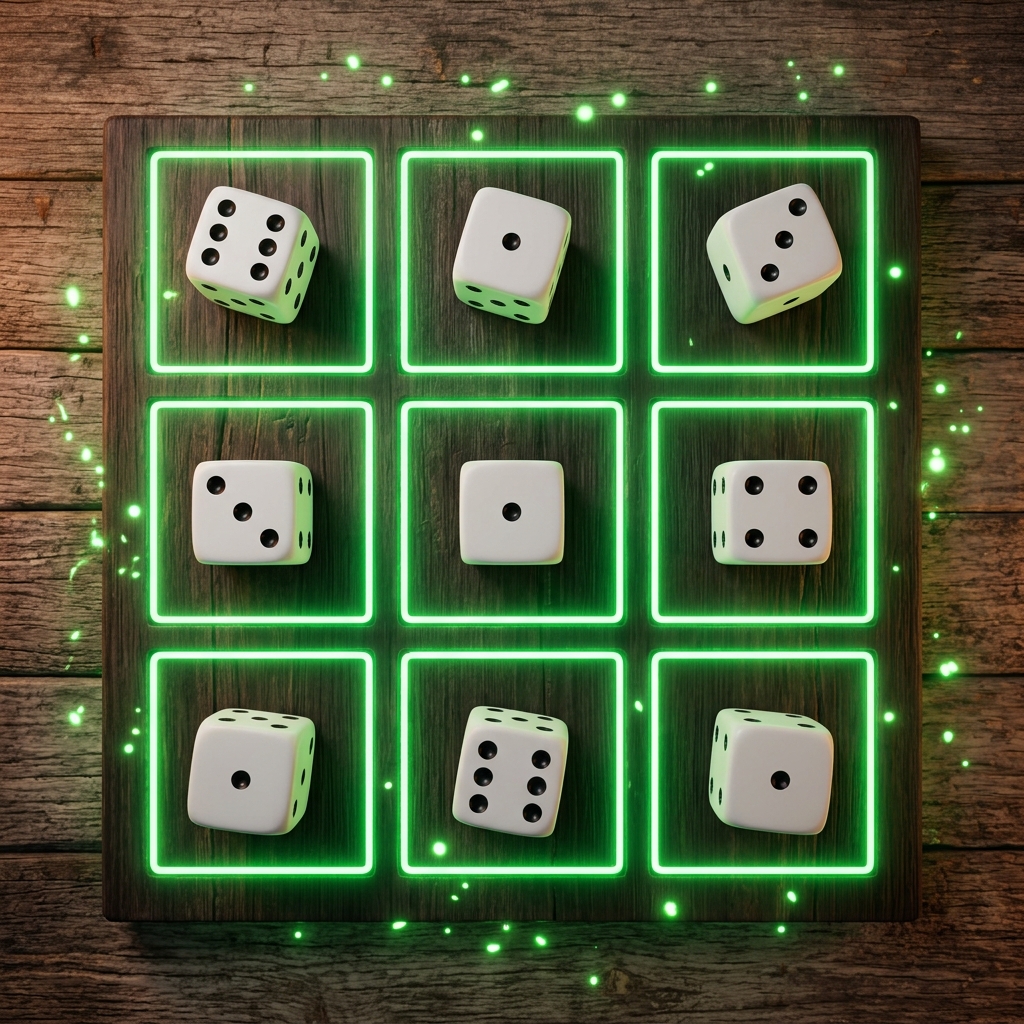
Step into the tactical arena of Knucklebones, a game where placement is power, matches are multiplied, and a single roll can obliterate your opponent's entire scoring column. Here is our complete breakdown of Knucklebones rules and master-level grid tactics.
1. Game Overview
In the Elegonn vs Player companion app, Knucklebones is a highly tactical placement game. The dice represent active score values. Aligning identical values in a column multiplies their power. But beware, if your opponent places a die of matching value in their corresponding column, yours will be destroyed and removed from the board.
This creates a dynamic balancing act: do you stack matching dice to maximize your column multipliers, or do you spread them out to avoid giving your opponent an easy opportunity to wipe them out?
"Stack your columns high, but do not leave them unguarded. A single matching roll from your opponent can bring your entire score crashing down."
2. History: Who, What, When, Why, Where
- Who: An ancient knucklebone game variant, modernized in digital games like Cult of the Lamb.
- What: A 3×3 grid tactical dice placement game featuring score multipliers and opponent die destruction.
- When: Traced back to Roman antiquity, modernized for mobile play in Elegonn vs Player.
- Why: To test spatial reasoning, calculation, and risk management under pressure.
- Where: Historically played in homes and encampments; now played anywhere on mobile devices.
3. The Real-World History of Knucklebones
The game of Knucklebones has a dual history tracing back to classical antiquity and modern digital game design. Historically, "knucklebones" (known as astragaloi in Greek or tali in Roman times) refers to one of the oldest games of chance and skill in human history. Played using the actual talus bones of cloven-hoofed animals (usually sheep, goats, or calves), these bones had four distinct, asymmetrical flat sides, each with a different probability of landing and a corresponding value:
- The Convex Side (Supinum / Pristis): Valued at 3.
- The Concave Side (Pronum): Valued at 4.
- The Flat Side (Planum): Valued at 1.
- The Twisted Side (Tortuosum): Valued at 6.
Romans used these bones for gambling, parlor games, and cleromancy (divination). The highest possible roll was the Venus Roll, achieved when all four bones landed on different faces. The worst roll was the Dogs (Canis), occurring when all four bones landed on the flat side (all 1s). Over centuries, these animal bones were replicated in bronze, silver, and glass, eventually evolving into the symmetrical cubic six-sided dice we use today.
The specific grid-placement ruleset featured in the Elegonn vs Player companion app was developed as a digital minigame by indie studio Massive Monster for their 2022 rogue-lite action game Cult of the Lamb. The game is set in a rustic cabin where players face off against a retired mentor named Ratau. It quickly gained a cult following of its own due to its elegant ruleset that balances high-yield scoring with immediate counter-attacks.
From a mathematical perspective, Knucklebones is a zero-sum game of complete information that can be analyzed using game theory. The scoring mechanic utilizes a quadratic multiplier: if a player places a die of value $V$ in a column containing $N$ copies of that die, the score for those dice is: \[Score = V \times N^2\] This means a single 6 scores 6 points, two 6s score 24 points ($6 \times 2^2$), and three 6s score 54 points ($6 \times 3^2$).
This steep exponential curve makes stacking dice highly lucrative but creates an intense risk profile. Because placing a matching die in the opponent's column destroys all of their matching dice in that column, the game features a powerful, built-in catch-up mechanic. A single move can swing the score by up to 54 points, resetting the opponent's grid state and prolonging the game.
4. Gameplay Rules
Each player has a 3×3 grid (three columns, three rows):
- The Turn: Roll a single 6-sided die. Place it in any open slot on your 3×3 grid.
- Column Scoring: The score of a column is calculated by adding the face values of the dice.
- Matches: If a column has identical dice, their values are multiplied.
- Two matching dice: (Value + Value) × 2 (or Value × 2²). For example, two 5s score 20 points.
- Three matching dice: (Value + Value + Value) × 3 (or Value × 3²). For example, three 6s score 54 points.
- Matches: If a column has identical dice, their values are multiplied.
- Destruction: If you place a die on your grid, and your opponent has one or more dice of the same value in their corresponding column, all of their matching dice are destroyed and removed from the board. Their remaining dice slide down to fill the empty spaces.
- Winning: The game ends immediately when either player's 3×3 grid is completely filled. The player with the highest total score wins.
5. Hints, Tricks & Strategies
To master the Knucklebones grid, you must play both offensively and defensively:
Offense is the Best Defense: Before placing a die, check if you can destroy any of your opponent's dice. Wiping out a high-value die (like a 5 or 6) is a double-benefit: it subtracts points from their score and opens up slots on their board, prolonging the game.
The Risk of Triple Stacks: Stacking three 6s in a column yields a massive 54 points. However, leaving three 6s exposed in a column is highly dangerous. If your opponent rolls a 6 and places it in their matching column, all 54 of your points vanish instantly.
Control the Pace of the Game: If you have a solid lead, you want the game to end quickly. Fill your columns with low-value, mismatched dice to take away rounds and lock in your victory. If you are trailing, keep columns open and fish for high-value doubles or destruction opportunities.